How to Build a Successful Digital Marketing Strategy for Your Business
Having an online presence is no longer enough for a business to stand out. With more companies competing for attention across search engines, social media, websites, and advertising platforms, businesses need a clear plan to reach the right people and turn their attention into meaningful results.
A digital marketing strategy provides that direction. Instead of publishing random posts or spending money on advertisements without a clear objective, businesses can use a structured approach to identify their audience, select suitable marketing channels, create valuable content, and measure performance.
Whether you operate a small local business, an online store, a service-based company, or a personal brand, developing a practical digital marketing strategy can make your marketing efforts more organized and effective.
1. Define Your Business Goals
The first step is to determine what you want your digital marketing activities to accomplish.
Different businesses may have different priorities. One company may want to increase online sales, while another may focus on generating leads, attracting visitors to its website, or building awareness around a new brand.
Common marketing objectives include:
- Increasing website traffic
- Generating qualified leads
- Improving online visibility
- Increasing product sales
- Growing social media engagement
- Building brand recognition
- Increasing customer retention
Your goals should be specific enough to measure. Instead of simply deciding to “get more customers,” a business could set a target for generating a certain number of qualified enquiries within a particular period.
Clear objectives make it easier to choose the right marketing channels and evaluate whether your strategy is producing useful results.
2. Understand Your Target Audience
A marketing campaign becomes much more effective when a business understands who it is trying to reach.
Your target audience may differ depending on your product, location, pricing, and industry. Research their interests, challenges, online habits, purchasing behavior, and reasons for choosing one brand over another.
For example, a company selling professional services may target business owners, while an online fashion store could focus on younger consumers who frequently use social media.
Understanding your audience can help you answer important questions:
- What problems are they trying to solve?
- Which platforms do they use?
- What type of content interests them?
- What factors influence their buying decisions?
- What questions do they ask before purchasing?
The answers can guide your content, advertising, messaging, and overall marketing approach.
3. Create a Strong Website
Your website often acts as the central point of a digital marketing campaign.
Social media posts, advertisements, search results, and email campaigns can all direct people toward your website. Because of this, the website should clearly explain what your business offers and make it easy for visitors to take the next step.
A professional website should generally have:
- Clear navigation
- Mobile-friendly design
- Fast-loading pages
- Useful and original content
- Clear contact information
- Strong calls to action
- Secure browsing
- Simple conversion processes
For example, if your goal is to generate enquiries, visitors should be able to find your contact form or enquiry button without having to search through multiple pages.
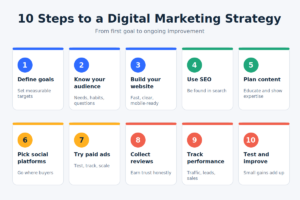
4. Use SEO to Improve Visibility
Search engine optimization can help your website become easier to discover when people search for information related to your business.
The process begins with understanding the terms your potential customers use when looking for products or services.
After identifying relevant search terms, businesses can create useful pages and articles that address those topics.
SEO can involve:
- Keyword research
- Content optimization
- Technical improvements
- Internal linking
- Website performance
- Mobile optimization
- Metadata optimization
- Building relevant authority
The objective should not simply be to insert keywords into a page. Content should provide genuine value and answer the user’s search intent.
Consistent SEO work can gradually improve a website’s visibility and help attract visitors who are already interested in related topics.
5. Develop a Content Strategy
Content gives businesses an opportunity to educate their audience and demonstrate their expertise.
A content strategy should have a clear purpose rather than relying on random topics.
Businesses can create:
- Blog articles
- YouTube videos
- Instagram posts
- Reels
- Tutorials
- Case studies
- Guides
- Infographics
- Customer stories
- Educational newsletters
For example, a digital marketing agency could create content explaining how small businesses can improve their online visibility.
Useful content can attract people who are searching for solutions and introduce them to your brand before they are ready to make a purchase.
6. Choose the Right Social Media Platforms
Businesses do not necessarily need to maintain an active presence on every social network.
Instead, focus on platforms where your target customers are most likely to spend time.
If your audience responds well to visual content, platforms focused on images and short videos may be useful. If you are targeting professionals and businesses, professional networking platforms may provide stronger opportunities.
The goal is to choose platforms based on audience behavior rather than simply following popularity.
Once the platforms are selected, maintain a consistent content schedule and monitor which topics receive the strongest response.
7. Consider Paid Advertising
Organic marketing can take time to build. Paid advertising provides another way to reach specific audiences and promote important offers.
Businesses can use search advertising, social media advertising, display campaigns, video advertisements, and other paid channels depending on their objectives.
Before launching a campaign, determine:
- Who should see the advertisement?
- What action should they take?
- What budget is available?
- Which message will be tested?
- Which landing page will receive visitors?
- How will performance be measured?
Running advertisements without tracking their results can make it difficult to understand whether the investment is generating value.
8. Build Trust Through Customer Reviews
Trust plays an important role in online purchasing decisions.
Potential customers may look at reviews, testimonials, ratings, case studies, and customer experiences before choosing a business.
Encourage genuine customers to share honest feedback about their experiences.
Businesses can also showcase useful testimonials on appropriate website pages and marketing materials.
However, reviews should remain authentic. Creating fake reviews may damage a company’s reputation and customer trust.
9. Track Marketing Performance
One of the biggest advantages of digital marketing is the amount of data available.
Businesses can monitor metrics such as:
- Website visitors
- Traffic sources
- Click-through rates
- Conversion rates
- Leads
- Sales
- Engagement
- Advertising costs
- Return on advertising spend
These numbers can reveal which campaigns are producing useful outcomes.
For example, if one advertising campaign generates many clicks but very few enquiries, the problem could be related to the advertisement, audience targeting, offer, or landing page.
Data allows marketers to identify these problems and make informed improvements.
10. Keep Testing and Improving
A digital marketing strategy should not remain unchanged forever.
Customer behavior, technology, competition, and online platforms continue to evolve. A campaign that performs well today may require adjustments later.
Businesses should regularly test different:
- Headlines
- Images
- Videos
- Offers
- Landing pages
- Keywords
- Audiences
- Content formats
Small improvements can make a meaningful difference when they are based on reliable performance data.
Common Mistakes to Avoid
Several mistakes can reduce the effectiveness of a digital marketing strategy.
One common problem is trying to use too many platforms without having enough resources to manage them properly.
Another issue is focusing only on promotional content. Audiences are more likely to engage when businesses provide useful information rather than constantly asking for a purchase.
Ignoring analytics is another major mistake. Without performance data, businesses may continue spending time and money on activities that produce limited results.
Finally, expecting immediate success can lead to poor decisions. Digital marketing often involves experimentation, learning, and gradual improvement.
Conclusion
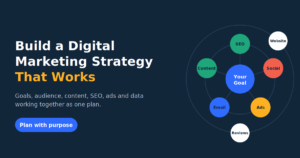
Building a successful digital marketing strategy requires more than creating social media posts or running advertisements. Businesses need to understand their goals, identify their audience, develop useful content, select appropriate platforms, optimize their online presence, and measure the results.
The strongest strategies are flexible. They use data to identify what is working and make changes when necessary.
Digital marketing is an ongoing process rather than a one-time activity. By combining clear objectives, valuable content, audience research, SEO, social media, paid advertising, and performance analysis, businesses can create a stronger foundation for sustainable online growth.
Plan with purpose, create value, measure the results, and keep improving.